

Static vs Dynamic Website – What’s the Difference?
Static vs Dynamic Website – What’s the Difference?
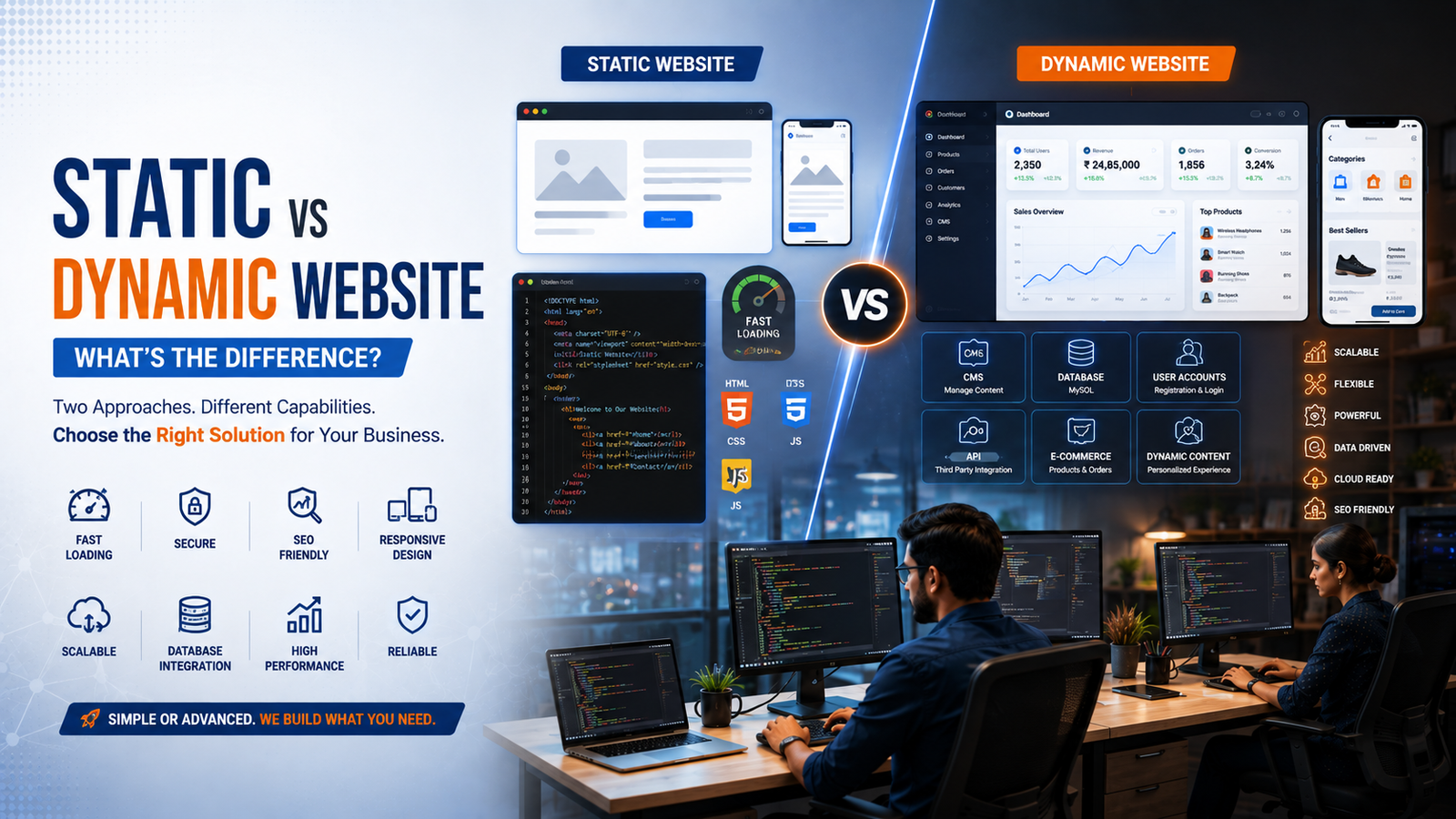
When planning a new online presence, one of the first technical decisions is choosing between a static and dynamic website. Although both types can help businesses establish an online presence, they work differently behind the scenes and offer different levels of flexibility, functionality, and maintenance.
Understanding the difference between a static and dynamic website can help business owners, startups, entrepreneurs, and organizations choose the right solution for their requirements. A simple business profile may work well with a static approach, while a growing company that needs regular updates, user accounts, e-commerce features, or database-driven functionality may benefit from a dynamic solution.
In this guide, we will explain what static and dynamic websites are, how they differ, their advantages and limitations, and which option may be more suitable for your business.
What Is a Static Website?
A static website consists of pre-built pages whose content remains relatively consistent unless a developer manually changes the underlying files.
These pages are generally created using technologies such as HTML, CSS, and JavaScript. When a visitor opens a page, the server delivers the stored files directly to the browser.
Static websites are commonly used for:
- Small business websites
- Portfolio websites
- Personal profiles
- Landing pages
- Event pages
- Company information websites
- Simple service websites
For example, if a business only needs pages such as Home, About Us, Services, Portfolio, and Contact, a static solution may provide everything required.
Advantages of Static Websites
Fast Loading
Because static pages usually contain fewer complex processes, they can load quickly when properly optimized. Faster loading can improve user experience and support search engine performance.
Simple Structure
A static website generally has a straightforward architecture, making it easier to understand and manage from a technical perspective.
Better Security
Since static sites often do not require databases or complex server-side systems, they can have fewer components that need protection.
Lower Development Requirements
For smaller projects with limited functionality, static development can sometimes be more affordable than building a complex dynamic platform.
Limitations of Static Websites
Static websites also have some limitations. Updating multiple pages may require technical knowledge, especially when there is no content management system.
They may not be ideal when a business needs:
- Frequently changing content
- Customer accounts
- Online bookings
- Product databases
- Personalized content
- Advanced search
- Complex forms
- Automated processes
If your business expects its online platform to expand significantly, a purely static approach may become restrictive.
What Is a Dynamic Website?
A dynamic website generates or displays content using server-side programming, databases, APIs, or content management systems.
Instead of storing every page as a fixed document, dynamic platforms can retrieve information and generate pages according to user requests.
Popular technologies used for dynamic development include PHP, Python, Node.js, Laravel, React-based systems, and various database technologies.
Dynamic websites are commonly used for:
- E-commerce stores
- News portals
- Educational platforms
- Customer portals
- Booking systems
- Social networks
- Business management platforms
- Membership websites
For example, an online store may have thousands of products. Rather than manually creating a separate page for every product, a dynamic system can retrieve product information from a database and generate the appropriate page automatically.
Advantages of Dynamic Websites
Easy Content Management
A dynamic platform can allow non-technical users to update text, images, products, blogs, and other information through an administrative interface.
This is particularly useful for businesses that publish content regularly.
Greater Functionality
Dynamic development supports advanced features such as:
- User registration
- Login systems
- Product catalogs
- Shopping carts
- Payment gateways
- Booking systems
- Customer dashboards
- Search functionality
- Database integration
Scalability
As a business grows, its digital requirements may become more complex. A dynamic website can often be expanded with new features, integrations, pages, and user functionality.
Personalization
Dynamic systems can display different information based on users, locations, preferences, accounts, or other conditions.
This makes them suitable for platforms where personalized experiences are important.
Static vs Dynamic Website: Key Differences
The main difference between static and dynamic development is how content is delivered and managed.
| Feature | Static Website | Dynamic Website |
| Content | Mostly fixed | Can change dynamically |
| Database | Usually not required | Often required |
| Updates | Often manual | Easier through CMS/admin panel |
| Functionality | Basic to moderate | Advanced |
| Development | Simpler | More complex |
| Maintenance | Generally simple | Requires regular management |
| Scalability | Limited for complex needs | Highly scalable |
| Personalization | Limited | Advanced |
| Best for | Small informational sites | Feature-rich platforms |
The right choice depends on what you want your website to accomplish today and how you expect your business to develop in the future.
Static vs Dynamic Website: Which Is Better for SEO?
Both static and dynamic websites can perform well in search engines when they are properly developed and optimized.
Search performance does not depend only on whether a site is static or dynamic. Other factors include:
- Page speed
- Mobile responsiveness
- Content quality
- Website structure
- Technical SEO
- Internal linking
- Metadata
- User experience
- Security
- Search intent
A well-built static site can rank effectively for relevant search terms. Similarly, a dynamic platform can perform strongly when its technical structure and content are properly optimized.
Therefore, businesses should choose technology based on functionality and business requirements rather than selecting one option solely for SEO.
Which Website Is Better for Small Businesses?
For a small business that only needs basic information, a static solution can be practical.
For example, a local service provider may only need:
- Home page
- About page
- Services
- Gallery
- Testimonials
- Contact page
If the content rarely changes, a static solution can be sufficient.
However, if the business wants to publish blogs, manage service pages frequently, add forms, integrate marketing tools, or expand its digital presence, a CMS-powered solution may be more convenient.
Which Website Is Better for E-commerce?
For an online store, a dynamic solution is generally more appropriate because e-commerce requires multiple interconnected functions.
An e-commerce platform may need:
- Product management
- Categories
- Customer accounts
- Shopping carts
- Payment processing
- Inventory management
- Order tracking
- Discounts
- Shipping integration
- Customer notifications
Managing these functions manually would be inefficient. A dynamic platform can automate many of these processes and provide a better experience for both customers and administrators.
Cost Difference Between Static and Dynamic Websites
The cost of development depends on design requirements, features, technology, content, integrations, and customization.
A basic static project may require less development work because it has fewer technical components.
A dynamic website can cost more because it may involve databases, APIs, user authentication, dashboards, payment systems, advanced functionality, and ongoing maintenance.
However, the cheapest option is not necessarily the most cost-effective.
If a business chooses a basic solution today and later needs to rebuild everything to support new requirements, the total cost may become higher.
It is better to consider both current requirements and future plans before making a decision.
How to Choose the Right Website Type for Your Business
Before selecting a development approach, consider the following questions:
How Frequently Will You Update Content?
If content will remain unchanged for long periods, static development may work well.
If you publish blogs, update products, add services, or regularly change information, a dynamic platform may be more convenient.
Do You Need User Accounts?
If customers need accounts, dashboards, order histories, or personalized information, dynamic development is generally more suitable.
Do You Need a Database?
Businesses managing products, customers, bookings, inventory, or large amounts of structured information will usually require database functionality.
Do You Expect Business Growth?
If you plan to add functionality over time, choose an architecture that can accommodate future requirements.
Do You Need a Content Management System?
A CMS allows authorized users to manage content without directly editing code. This can save time and make day-to-day management easier.
Can a Website Be Both Static and Dynamic?
Yes. Modern development does not always require choosing a completely static or completely dynamic approach.
Many modern platforms use a combination of techniques. Some pages can be generated statically for speed, while other sections can retrieve information dynamically.
For example, a business platform could have static informational pages while using dynamic functionality for customer accounts, product catalogs, or booking systems.
This hybrid approach can provide a balance between performance, flexibility, and functionality.
Why Professional Website Development Matters
Whether you choose a static or dynamic platform, professional development plays an important role in the final result.
A professionally developed website should provide:
- Responsive design
- Fast loading
- Clear navigation
- Secure functionality
- SEO-friendly structure
- Mobile compatibility
- Accessible content
- Reliable performance
- Scalable architecture
Technology should align with your business objectives without adding unnecessary complexity.
At Codes Wizards, we develop business websites and digital solutions based on individual project requirements. From simple corporate sites to customized web applications and e-commerce platforms, the development approach is selected according to functionality, audience, and future objectives.
Static vs Dynamic Website: Final Verdict
There is no universal answer to whether a static or dynamic website is better.
A static solution can be an excellent choice for businesses that need a simple, fast, secure, and easy-to-maintain online presence. On the other hand, dynamic development is better suited to organizations that require frequent updates, databases, user accounts, e-commerce functionality, automation, or advanced integrations.
Before making a decision, consider your budget, current requirements, content management needs, expected traffic, functionality, and future growth plans.
Choosing the right technology from the beginning can help you create a more effective digital foundation for your business.
Frequently Asked Questions
1. Static vs Dynamic Websites: What’s the Key Difference?
A static site generally delivers fixed content, while a dynamic site can generate or update content using databases, server-side technologies, APIs, or content management systems.
2. Is a static website faster than a dynamic website?
A static site can be very fast because it typically involves fewer server-side processes. However, a properly optimized dynamic platform can also deliver excellent performance.
3. Are static websites good for SEO?
Yes. Static websites can rank well when they have useful content, proper technical SEO, fast loading speeds, mobile responsiveness, and a strong site structure.
4. Is WordPress a static or dynamic platform?
WordPress is primarily a dynamic content management system because it commonly uses a database to store and retrieve website content.
5. Which option is better for an online store?
Dynamic development is generally more appropriate for e-commerce because online stores require product management, orders, payments, customer accounts, inventory, and other interactive features.
6. Can a static website be converted into a dynamic website?
Yes. A static site can be redesigned or rebuilt using a CMS or custom development framework when additional functionality becomes necessary.
7. Which option is more affordable?
A simple static site may have lower initial development requirements, while a dynamic site generally requires more development because of its advanced functionality.
8. How do I know which option my business needs?
Consider how frequently you will update content, whether you need databases or customer accounts, the functionality you require, and how much you expect your business to grow.
Conclusion
Understanding the difference between static and dynamic development helps businesses make better technology decisions. The ideal solution should match your current requirements while leaving enough room for future improvements.
If you are unsure which approach is suitable for your business, a professional development team can evaluate your goals, functionality, budget, and growth plans before recommending the right solution.
Need help choosing the right website development approach? Contact Codes Wizards to discuss your requirements and build a professional online solution tailored to your business.

Author